
-300x300.jpg)
-300x300.jpg)


-300x300.jpg)


-300x300h.jpg)

-300x300.jpg)


-300x300.jpg)
-300x300.jpg)
-300x300.jpg)

-300x300.jpg)
-300x300.jpg)


Body Protection

Contents
- 1. Overview
- 2. Key Standards
- 2.1 EN 13034 – Limited Chemical Splash Protection (Type 6)
- 2.2 EN ISO 13982-1 – Protection Against Airborne Solid Particulates (Type 5)
- 2.3 EN 14605 – Liquid Chemical Protection (Type 3 and Type 4)
- 2.4 EN 14325 – Test Methods and Performance Classification for Chemical Protective Clothing
- 2.5 EN ISO 11612 – Heat and Flame Protection
- 2.6 EN 14126 – Protection Against Infective Agents
- 3. Clothing Types and Their Role
- 3.1 Coveralls and Suits
- 3.2 Gowns, Aprons, and Oversleeves
- 3.3 Hoods and Hairnets
- 3.4 Labcoats
- 3.5 Contamination-Control Garments (Product Protection)
- 4. What the Standards Mean in Practice
- 4.1 Understanding Protective Clothing Types
- 4.2 Performance Levels Under EN 14325
- 4.3 Heat and Flame Performance Under EN ISO 11612
- 4.4 EN 14126 in Context
- 5. Cleanroom Relevance
- 5.1 Contamination Control — Protecting the Product
- 5.2 Operator Safety — Protecting the Person
- 6. Selection Considerations
- Frequently Asked Questions
1. Overview
Body protection in semiconductor and Microelectronics cleanrooms serves two distinct functions: protecting the wearer and protecting the product. Personal protective equipment (PPE) guards the wearer against the chemical, thermal and physical hazards of the manufacturing environment. Other garments contain the particles, fibres and residues shed by personnel, preventing them from reaching the wafer. A single garment may perform one function or both, and the two should be assessed separately.
This guide covers the full body-protection gowning system used in these environments. The standards it explains apply to PPE — garments rated against a hazard to the wearer, such as chemical protective suits, chemical aprons, protective hoods and heat- and flame-resistant clothing. Where such garments protect against risks of serious or irreversible harm, they fall under Category III of PPE Regulation (EU) 2016/425.
Several garments common in cleanrooms serve to protect the product rather than the wearer — particle-containment coveralls, cleanroom hoods, hairnets, bouffant caps, beard covers and overshoes. Their contamination-control role is not a protective function for the person wearing them; where such items carry PPE marking, it is typically Category I, covering minimal risks only. They are included in this guide because they form part of the same gowning system, but they are identified throughout as product protection. Identifying which function each garment performs determines both the item selected and the standard that applies, and selection should consider the gowning system as a whole rather than individual items in isolation.
2. Key Standards
The following standards apply to garments classified as PPE — those that protect the wearer.
2.1 EN 13034 – Limited Chemical Splash Protection (Type 6)
EN 13034 defines the requirements for protective clothing offering limited protection against liquid chemical splash. Type 6 garments are designed for low-level, short-duration contact with liquid chemicals where the risk of saturation or immersion is not present. This standard is relevant to Microelectronics manufactures where incidental chemical splash is a foreseeable risk, for example during the handling of cleaning chemicals or low-concentration process liquids, but where the exposure level does not require a higher-rated chemical suit. Type 6 represents limited liquid splash protection and is often used where comfort and mobility are priorities alongside basic chemical splash protection.
2.2 EN ISO 13982-1 – Protection Against Airborne Solid Particulates (Type 5)
EN ISO 13982-1 defines requirements for chemical protective clothing providing full-body protection against airborne solid particulates. It is intended for exposure to hazardous solid particulates dispersed in air, rather than as a general cleanroom garment standard. In Microelectronics and adjacent high-technology manufacturing, Type 5 garments may be relevant where hazardous airborne solid particulates present an operator exposure risk during specific handling, cleaning or maintenance activities. Type 5 garments are commonly combined with Type 6 protection, and many suits on the market carry both classifications.
2.3 EN 14605 – Liquid Chemical Protection (Type 3 and Type 4)
EN 14605 specifies protective clothing designed to protect against liquid chemical hazards. Type 3 garments provide protection against pressurised liquid chemical jets, while Type 4 garments provide protection against liquid chemical spray.
In semiconductor wafer fabrication, wet bench processes use chemicals such as hydrofluoric acid (HF), sulphuric acid, nitric acid and other corrosive substances. However, routine wafer cleaning operations are typically conducted within enclosed or engineered wet processing equipment that is designed to control chemical exposure. As a result, EN 14605 Type 4 chemical protective clothing is not normally required solely for standard wafer cleaning activities.
Type 3 or Type 4 chemical protective garments may be required for non-routine tasks where there is an increased risk of chemical exposure, such as equipment maintenance, chemical line breaking, spill response, decontamination activities, or emergency situations. The selection of protective clothing should always be based on a documented risk assessment that considers the chemicals involved, the potential exposure scenario, and the effectiveness of existing engineering controls.
2.4 EN 14325 – Test Methods and Performance Classification for Chemical Protective Clothing
EN 14325 defines the test methods and performance classification framework used to assess chemical protective clothing materials and seams. It underpins the Type classifications defined in EN 13034, EN ISO 13982-1, and EN 14605. The standard sets out test methods for a range of material and seam properties, including abrasion resistance, flex cracking resistance, puncture resistance, tensile strength, and seam strength. These results allow comparison between garments within the same Type classification.
2.5 EN ISO 11612 – Heat and Flame Protection
EN ISO 11612 defines the requirements for protective clothing intended to protect against heat and flame. It covers hazards including convective heat, radiant heat, contact heat, and molten metal splash. In semiconductor manufacturing, potential thermal hazards may arise during tasks such as furnace-related maintenance, hot quartzware handling, or work near high-temperature process equipment. Where personnel work in proximity to these processes, garments meeting EN ISO 11612 may be required as part of the risk control strategy.
Performance is expressed across multiple lettered codes:
- A covers limited flame spread
- B covers convective heat
- C covers radiant heat
- D covers molten aluminium splash
- E covers molten iron splash
- F covers contact heat
Each code is accompanied by a performance level. Garment selection should be based on the specific thermal hazards identified in the risk assessment rather than the highest available rating across all codes.
2.6 EN 14126 – Protection Against Infective Agents
EN 14126 specifies performance requirements and test methods for protective clothing intended to protect against infective agents. It is not a standalone garment classification and is typically used in conjunction with a protective clothing Type standard such as Type 3, Type 4, Type 5, or Type 6. The standard includes test methods that assess resistance to penetration by contaminated liquids, biological aerosols, and viral agents.
EN 14126 is not generally relevant to semiconductor or microelectronics manufacturing, where biological hazards and infective agents are not a recognised occupational risk. In these industries, protective clothing is selected primarily to control contamination, particulate release, and exposure to chemical hazards rather than protection against biological agents.
The standard is, however, highly relevant in industries where exposure to infective agents may occur, including pharmaceutical manufacturing, biotechnology, healthcare, medical research, clinical laboratories, and other life sciences environments. In such settings, garments certified to EN 14126 may be required alongside the appropriate chemical or particulate protection standard, depending on the nature of the hazard and the level of exposure risk identified through the workplace risk assessment.
3. Clothing Types and Their Role
The garments below are grouped by function. Sections 3.1–3.3 cover PPE that protects the wearer; sections 3.4–3.5 cover garments whose primary function is protecting the product.
3.1 Coveralls and Suits
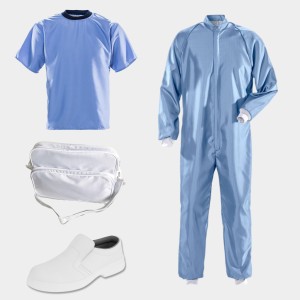
In semiconductor wafer manufacturing, cleanroom garments are selected primarily to minimise particle generation and contamination of the product and process environment. Due to the extremely high sensitivity of wafer fabrication processes, particularly within ISO Class 5 and cleaner environments, reusable cleanroom coveralls manufactured from tightly woven polyester fabrics are generally the preferred solution. These garments are designed for repeated specialist laundering and qualification, providing consistent contamination-control performance, low particle shedding, and compatibility with electrostatic discharge (ESD) control programmes.
Disposable non-woven coveralls may be used in less critical electronics manufacturing environments, including many ISO Class 6, ISO Class 7 and ISO Class 8 cleanrooms, where contamination control requirements are less stringent. They may also be used within semiconductor facilities for specific applications such as maintenance activities, contractor access, shutdown work, or other controlled tasks where permitted by site procedures.
The suitability of reusable or disposable garments should be determined by the cleanroom classification, process sensitivity, contamination-control requirements, ESD considerations, and the facility's overall contamination control strategy. In all cases, garment selection should be based on demonstrated performance within the intended operating environment rather than cleanroom classification alone.
3.2 Gowns, Aprons, and Oversleeves
During wafer cleaning, wet processing and chemical handling operations, supplementary PPE may be worn to provide additional protection against chemical splashes without requiring a change to the primary cleanroom garment system. Common examples include aprons, gowns, oversleeves and boot covers, which provide targeted protection to the areas most likely to be exposed.
Many of these garments are certified as Partial Body (PB) protective clothing, meaning they protect specific parts of the body rather than providing full-body coverage. Examples include garments certified to EN 14605 Type PB(4) for spray-tight protection or Type PB(3) for protection against pressurised liquid splashes. Partial-body garments are commonly used in semiconductor wet processing because they can be worn over existing cleanroom apparel while providing additional protection where it is needed most.
Chemical protective gowns or aprons with separate sleeves are widely used at wet benches and chemical handling stations to protect the front of the body from splash hazards. Oversleeves provide additional protection for the arms and forearms, while gown-style garments and boot covers may be used where site procedures require extended coverage.
The level of protection required should be determined by the facility's risk assessment and chemical hazard evaluation. Depending on the chemicals, exposure scenario and task being performed, supplementary garments may be certified to EN 13034 Type PB(6), EN ISO 13982-1 Type PB(5), or EN 14605 Type PB(4) or Type PB(3). Selection should also consider compatibility with contamination-control requirements and established donning and doffing procedures.
3.3 Hoods and Hairnets
In semiconductor wafer manufacturing, personnel typically wear a hair cover together with a cleanroom hood, or a coverall incorporating an integrated hood, as part of the cleanroom garment system. The primary purpose of these garments is to contain particles, hair and skin flakes generated by the wearer, thereby protecting the product and cleanroom environment from contamination. As such, cleanroom hoods are generally considered contamination-control garments rather than PPE. See 3.5 for more details.
In highly contamination-sensitive applications, specialist hood systems may also be used to further reduce particles generated by personnel. These systems may incorporate face visors, filtered airflow, or extraction technologies designed to capture and remove particles generated by breathing, speaking and other human activity before they can enter the cleanroom environment. Like conventional cleanroom hoods, their primary purpose is product protection rather than wearer protection.
In some applications, hoods may also form part of a PPE system. Examples include hoods integrated into chemical protective garments certified to EN 14605 Type 3 or Type 4, which extend chemical protection to the head, neck and shoulders, or hoods used as part of respiratory protective equipment (RPE), powered air-purifying respirators (PAPRs), and supplied-air systems. In these cases, the hood is intended to protect the wearer from a specific hazard and may fall within Category III of PPE Regulation (EU) 2016/425 where protection against serious or irreversible harm is required.
The distinction is therefore based on the garment's intended purpose: cleanroom hoods and specialist contamination-control hood systems are used primarily for product and process protection, whereas PPE hoods are used to protect the wearer against identified workplace hazards.
3.4 Labcoats
Labcoats are commonly used in laboratories, support areas, and lower-grade controlled environments where full coveralls are not required. Their purpose and level of protection can vary significantly depending on the garment design and certification.
Many labcoats, including visitor coats, are intended primarily for contamination control, cleanliness, or general workplace clothing and should not be assumed to provide protection against chemical, particulate, thermal, or other workplace hazards. Such garments are not PPE unless specifically certified for a protective purpose.
Where wearer protection is required, labcoats may be certified as partial-body protective clothing. Depending on the hazards present, garments may achieve classifications such as EN 13034 Type PB(6) for limited liquid splash protection, EN ISO 13982-1 Type PB(5) for protection against airborne solid particulates, or other relevant standards. These garments are designed to protect specific body areas while allowing integration with other PPE.
In semiconductor environments, labcoats are more commonly used in support areas, laboratories, engineering spaces, and research and development facilities than in the main manufacturing cleanroom. Selection should be based on the garment's intended purpose and the results of the workplace risk assessment, rather than on garment style alone.
3.5 Contamination-Control Garments (Product Protection)
The following garments protect the clean environment rather than the wearer. Where they carry PPE marking, it is typically Category I, covering minimal risks only. They form part of the gowning system, but their function is product protection rather than body protection for the person.
- Cleanroom hoods contain hair and scalp particles and, in higher-control cleanrooms, take a balaclava-style form that integrates with the coverall collar. Made from low-shedding cleanroom fabric, they may incorporate conductive fibres for ESD control.
- Hairnets, bouffant caps and beard covers contain head and facial-hair particles. These are general-hygiene items widely used in food handling; they are not cleanroom-grade and should not be relied upon as the primary head covering in a controlled environment, where a cleanroom hood is appropriate.
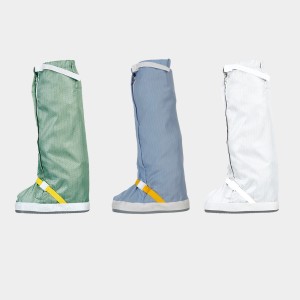
- Overshoes and overboots contain the dirt, particles and residues carried on footwear. Cleanroom overboots and dedicated cleanroom footwear give the most reliable containment and can be specified with conductive properties for ESD control; thin disposable overshoes offer only basic, short-term coverage and can themselves become a particle source as they wear, suiting low-risk or visitor access rather than routine cleanroom work.
4. What the Standards Mean in Practice
4.1 Understanding Protective Clothing Types
The Type classification system describes the level and form of protection a garment offers against chemical hazards:
| Type | Protection against | Relevant standard |
|---|---|---|
| Type 3 | Pressurised liquid jets | EN 14605 |
| Type 4 | Liquid spray | EN 14605 |
| Type 5 | Airborne solid particulates | EN ISO 13982-1 |
| Type 6 | Limited liquid splash | EN 13034 |
Type Protection against Relevant standard
Type 3 Pressurised liquid jets EN 14605
Type 4 Liquid spray EN 14605
Type 5 Airborne solid particulates EN ISO 13982-1
Type 6 Limited liquid splash EN 13034
A higher Type number does not automatically mean more protection. The Types primarily describe different hazard scenarios rather than a simple performance hierarchy. Many garments carry multiple Type classifications, for example a Type 5/6 suit offers both solid particle and limited liquid splash protection.
4.2 Performance Levels Under EN 14325
EN 14325 provides test methods and performance classification for a range of material and seam properties including abrasion resistance, flex cracking, puncture resistance, tensile strength, and seam strength. Performance is expressed as levels for individual material and seam properties, with higher values indicating improved performance in that specific test. When comparing garments within the same Type classification, EN 14325 performance levels allow more meaningful differentiation between products. A Type 6 garment with higher EN 14325 material ratings will generally offer greater durability and more reliable protection than one with lower ratings.
4.3 Heat and Flame Performance Under EN ISO 11612
EN ISO 11612 garments are assessed against specific thermal hazards rather than as a single overall rating. A garment may be certified for one hazard code without being tested for others. Selection should be based on the specific hazards identified in the risk assessment rather than the overall range of codes a garment carries.
4.4 EN 14126 in Context
EN 14126 is most relevant in pharmaceutical, biotech, and healthcare environments. In semiconductor cleanrooms, biological hazard control is not typically a primary concern and this standard will not be relevant to most operations. Where it is applicable, garments must demonstrate resistance to penetration by contaminated liquids, and where virus protection is claimed, must meet additional testing requirements. These requirements apply alongside the base garment Type classification.
5. Cleanroom Relevance
5.1 Contamination Control — Protecting the Product
This is the role most cleanroom body covering plays. In semiconductor manufacturing, personnel are a major source of airborne contamination. The human body continuously sheds skin particles, hair, and fibres, which can enter the cleanroom environment and deposit on silicon wafers, affecting process quality, device performance and yield.
The primary function of cleanroom body covering is to act as a barrier between the person and the environment, containing contamination at source rather than relying on air filtration alone. This is why cleanroom garments are designed with low particle and fibre shedding characteristics and are worn as a complete system. Cleanroom hoods, caps, beard covers and overshoes all belong to this contamination-control role — they protect the product, not the wearer.
Research has shown that contaminants such as sodium (Na), potassium (K), and calcium (Ca) are commonly associated with the human body, particularly from perspiration and saliva. These ionic species can transfer to wafers or process equipment through direct or indirect contact. In wafer fabrication, even trace levels of ionic contamination can affect device performance, increase leakage currents, and reduce yield. Garments should therefore be specified for low extractable ion content where this risk is present. Garment cleanliness, material composition, laundering, packaging, and processing can all influence overall cleanliness performance.
5.2 Operator Safety — Protecting the Person
This is the role that makes a garment true body PPE. Semiconductor wafer fabrication involves a wide range of hazardous substances including strong acids, oxidising chemicals, solvents, dopant sources, and process gases, some of which are toxic or flammable. Body protection forms an essential part of the control strategy for these hazards.
The correct garment type must be matched to the specific hazard. A cleanroom coverall designed for contamination control will not provide adequate protection against chemical exposure. Where chemical or thermal hazards are present, garments must meet the relevant Type classification and be selected on the basis of a formal risk assessment. In the UK, this is addressed under the Control of Substances Hazardous to Health (COSHH) Regulations, with equivalent legislation applying in other jurisdictions. COSHH requires employers to assess exposure risk and implement appropriate controls, with PPE including protective clothing used as part of a wider control strategy rather than as the primary control measure.
Chemical protective clothing intended to protect against serious risks requires third-party conformity assessment under applicable PPE legislation. In Great Britain, PPE placed on the market must meet applicable legal requirements and may currently carry CE or UKCA marking, depending on the product and route to market.
6. Selection Considerations
- Identify the role first — protecting the product or the wearer. Many cleanroom garments protect the environment, not the person. Be clear which job each item is doing before you select it.
- Identify the hazard before selecting the garment. Contamination control, chemical splash, hazardous airborne particulates, heat, flame, and biological agents each require different garment characteristics. A single garment may need to address more than one simultaneously.
- Do not assume a higher Type number means better protection — for liquid protection the reverse is generally true. Type 3 (pressurised jet) offers greater liquid protection than Type 6 (light splash), while Type 5 addresses hazardous airborne solid particulates, a different hazard again.
- Consider the full garment system. Body covering in a cleanroom is a coordinated system of coverall, hood, face mask, gloves, and overboots. Gaps between components are a common source of contamination and exposure risk.
- Match fabric properties to the cleanroom classification. Higher-control cleanrooms require garments with lower particle and fibre shedding. Fabric construction, laundering and packaging all affect cleanliness performance in use.
- Consider ESD requirements. Where electrostatic discharge control is required, garments with conductive fibres may be used as part of a wider ESD control programme, alongside suitable flooring, footwear grounding, wrist straps and other controls where appropriate.
- Account for garment cleanliness and ionic content. Where ionic contamination is a concern, select garments tested for low extractable levels of Na, K, Ca, and Mg.
- For chemical protective clothing, verify compatibility with the specific chemicals present. Type classifications describe the category of exposure; confirm the specific chemicals a garment has been tested against before finalising selection.
- Check conformity marking. Chemical protective clothing intended to protect against serious risks requires third-party conformity assessment. In the EU this is reflected in CE marking where required; in Great Britain, PPE must meet applicable product safety requirements and carry the required conformity documentation and marking for the market in which it is placed.
- For disposable garments, consider durability over the intended period of use. Garment degradation during use — particularly thin overshoes and lightweight coveralls — can itself become a particle source.
- Standards and regulations may be updated over time. Always verify current certification and suitability for your specific application.
Frequently Asked Questions
Do cleanroom hoods, caps and overshoes count as PPE?
Their function is contamination control, not wearer protection. Cleanroom hoods, hairnets, bouffant caps, beard covers and overshoes contain the particles, hair and residues shed by personnel to protect the product and the clean environment. Where these items carry PPE marking, it is typically Category I, covering minimal risks only. PPE body protection in the meaningful sense — garments rated against a hazard to the wearer — means chemical protective suits, chemical-suit hoods and heat- and flame-resistant clothing.
Is a cleanroom hood the same as a PPE hood?
No. A cleanroom hood is worn for particle containment — it protects the product by containing hair and scalp particles, and is not PPE. A PPE hood protects the wearer: it forms part of a chemical protective suit, extending Type 3 or Type 4 protection to the head, or part of respiratory protective equipment. They can look similar but serve opposite functions, so confirm which one a product is before relying on it.
Are bouffant caps and beard masks suitable for cleanrooms?
They are general-hygiene items, common in food handling, rather than cleanroom-grade equipment. In a controlled environment the appropriate head and facial-hair covering is a cleanroom hood. Basic caps and beard covers should not be relied upon as the primary covering in a cleanroom.
What is a Type 5/6 coverall?
A Type 5/6 coverall meets both EN ISO 13982-1 (Type 5, protection against airborne solid particulates) and EN 13034 (Type 6, limited liquid chemical splash). Many disposable coveralls carry both classifications, making them suitable where hazardous airborne solid particulates and incidental light splash are the foreseeable risks.
Are cleanroom coveralls chemical resistant?
Not necessarily. A coverall selected for particle containment may offer little or no chemical protection. Chemical resistance is only assured where the garment is certified to the relevant Type standard — for example Type 3 or Type 4 under EN 14605 — for the specific chemicals present. Where both contamination control and chemical protection are needed, the two requirements must be checked separately.
What does EN ISO 11612 cover?
EN ISO 11612 specifies requirements for clothing that protects against heat and flame, including convective, radiant and contact heat and molten metal splash. Performance is given as lettered codes A to F, each with a performance level. Garments should be chosen against the specific thermal hazards in the risk assessment, not the widest range of codes a garment happens to carry.
What is the difference between Type 3 and Type 4 protective clothing?
Both are covered by EN 14605. Type 3 protects against pressurised liquid chemical jets; Type 4 protects against liquid chemical spray. Type 3 provides the higher level of liquid protection; the correct choice depends on whether the foreseeable exposure is a jet or a spray.
Why is body protection important in a semiconductor cleanroom?
It serves two distinct purposes. It contains the particles, hair and fibres shed by personnel, which would otherwise settle on wafers and reduce yield, and — where garments are chemically or thermally rated — it protects the operator from the acids, solvents and process chemicals used in wafer fabrication. These two functions are not always met by the same garment, so selection should consider the full system together.